


The United Nations Organization Stabilization Mission in the DRC (MONUSCO), through its Mine Action Service (UNMAS), has inaugurated in Beni, the provisional capital of North Kivu, the country’s very first Demining Training Center. It represents a major milestone in strengthening national demining capacities in the Democratic Republic of the Congo.
Located at the MONUSCO base in Mavivi, about ten kilometers from downtown Beni, the center represents significant progress in addressing the persistent threat of explosive devices and in efforts to better protect civilian populations in the region.
Strengthening national capacities
With a capacity to host 28 trainees, the center will train national specialists in explosive ordnance disposal (EOD Levels 1 and 2). Each training cycle will last ten weeks.
“This is a first at the national level,” said Jean-Denis Nsoki Larsen, Head of MONUSCO’s Mine Action Section.
“Until now,” he continued, “all Congolese experts were trained abroad. This center will significantly increase the number of specialists available in the country. The center here will train specialists in the identification, neutralization, and removal of explosive devices (EOD). Trainees will first learn how to neutralize all kinds of conventional ammunition, and later they will also learn how to neutralize improvised explosive devices.”
Trainees will acquire essential skills ranging from the identification of conventional ammunition to the neutralization of improvised explosive devices (IEDs).
Toward Greater Autonomy for Congolese Forces
Beyond technical training, the initiative is part of a broader strategy aimed at empowering national forces, particularly the Congolese National Police and the Armed Forces of the DRC (FARDC).
The objectives are threefold:
- Train EOD teams capable of operating independently;
- Gradually reduce dependence on international support;
- Sustainably improve civilian protection.
This project also marks an important step toward the gradual transfer of expertise within the framework of long-term stabilization efforts.
First Soldiers Graduate
On May 15, 2026, eight FARDC soldiers from various units received their Level 1 EOD qualification certificates, becoming the first graduates of the center.
Over a three-week period, they underwent intensive training combining theory and practice, covering areas such as trauma care applied to demining operations, recognition and classification of ammunition, technical organization of operations, human rights principles, and marking techniques for unexploded ordnance.
This training is a first and represents major progress for the FARDC. We have acquired essential skills in accordance with international standards. It is now important for the government to support us by providing the necessary equipment,
Why Beni?
According to UNMAS, the choice of Beni was strategic.
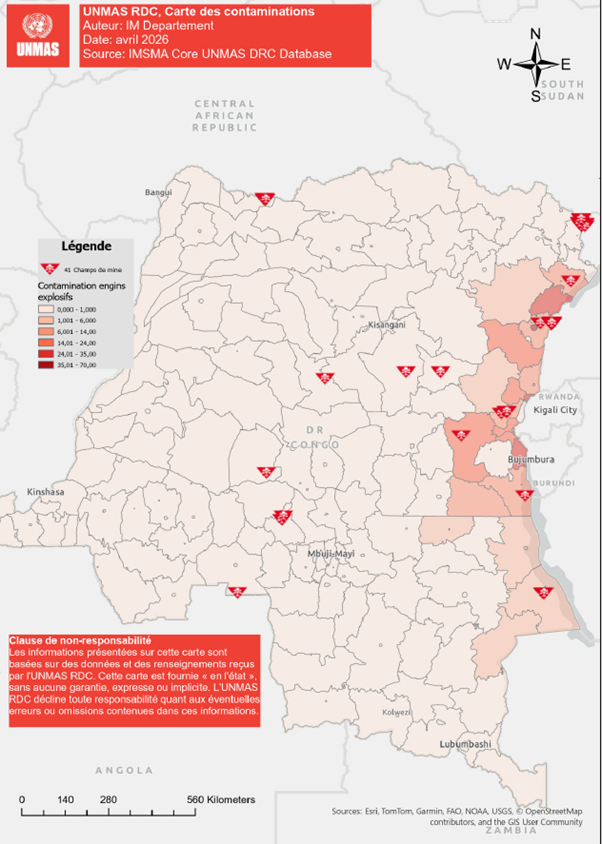
The region is heavily affected by armed conflict, resulting in significant contamination of the environment by unexploded ordnance (UXO), improvised explosive devices (IEDs), and explosive remnants of war (ERW).
Training in Beni therefore means training at the heart of high-risk zones, where operational needs are most urgent.
“The issue of explosive devices in the DRC remains one of the major concerns regarding civilian protection, particularly in the eastern part of the country. Among the provinces most affected by this phenomenon are Ituri, North Kivu, and South Kivu,” emphasized Jean-Denis Nsoki Larsen.
The consequences for civilians are numerous: loss of life and serious injuries, forced displacement of populations, and obstacles to economic development, particularly in the agricultural sector.
Contaminated land often becomes unusable, worsening food insecurity and limiting access to essential resources such as water, roads, and farmland.
Even the mere suspicion of the presence of mines can isolate entire communities.
Jean-Tobie OKALA


