

The United Nations Joint Human Rights Office (UNJHRO) has sounded the alarm over the scale of conflict-related sexual violence (CRSV) in the Democratic Republic of the Congo (DRC). Beyond the alarming figures documented in 2025, UNJHRO warns of the systematic use of rape as a weapon of war and the emergence of a generation of children facing stigma and exclusion.
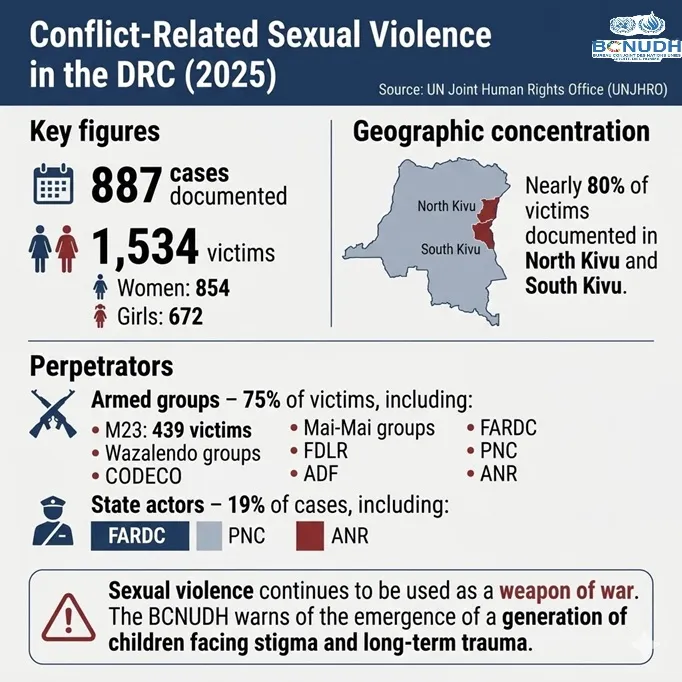
According to data collected by UNJHRO, 887 cases of conflict-related sexual violence were documented in 2025, affecting 1,534 victims, the vast majority of whom were women (854) and girls (672).
Eastern DRC remains the epicenter of the violence
The provinces of North Kivu and South Kivu account for nearly 80 percent of the documented victims, underscoring the persistent insecurity affecting eastern parts of the country.
According to UNJHRO, armed groups are responsible for 75 percent of the victims. The March 23 Movement (M23) accounts for the highest number, with 439 victims, followed by Wazalendo groups, the Cooperative for the Development of the Congo (CODECO), various Mai-Mai groups, as well as the Democratic Forces for the Liberation of Rwanda (FDLR) and the Allied Democratic Forces (ADF).
UNJHRO also notes with concern the involvement of State actors. Members of the Armed Forces of the Democratic Republic of the Congo (FARDC), the Congolese National Police (PNC) and the National Intelligence Agency (ANR) were implicated in 19 percent of the documented cases.
Sexual slavery and children born of rape
The report highlights particularly serious abuses, including sexual slavery, in which women and girls are held in prolonged captivity and subjected to repeated rape and forced pregnancies.
UNJHRO also draws attention to the situation of children born of rape, who often face family rejection, lack civil registration and remain at heightened risk of social exclusion and recruitment by armed groups.
Insufficient support for survivors
While 70 percent of victims have access to emergency medical care, less than 2 percent receive comprehensive support, including legal, psychological and social assistance.
According to UNJHRO, this gap leaves thousands of survivors without the support needed to address the long-term physical and psychological consequences of the violence they have endured.
In light of the seriousness of the situation, UNJHRO calls for urgent action at multiple levels.
National authorities are urged to accelerate judicial proceedings against perpetrators of serious crimes and to ensure the systematic civil registration of children born of rape in order to break the cycle of exclusion.
Armed groups are called upon to immediately cease hostilities, release without conditions all women and girls held in captivity, and end the practice of sexual slavery.
UNJHRO also calls on the international community to strengthen financial support for comprehensive and sustainable assistance for survivors, going beyond emergency medical care.