


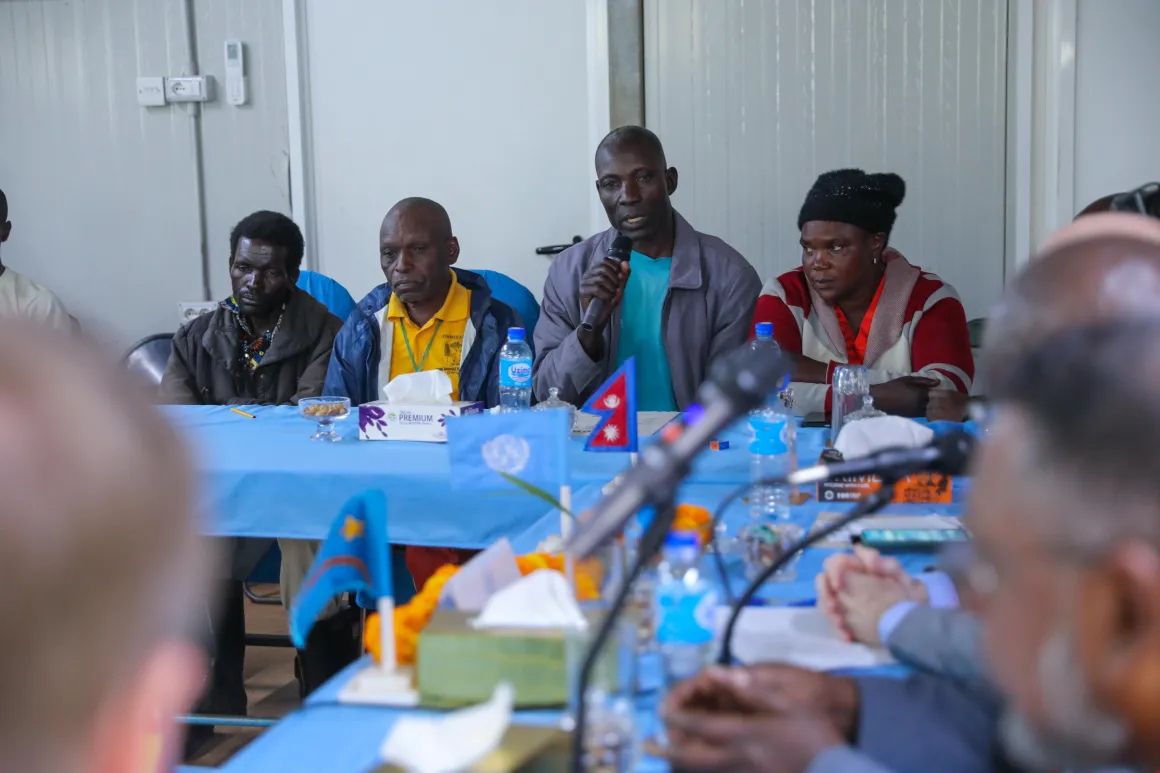
On the final day of his visit to Ituri, Thursday, 23 April 2026, the Head of MONUSCO, James Swan, travelled to Fataki in Djugu territory, where the Mission’s Nepalese contingent base remains a key platform for the protection of civilians and a place of refuge for many displaced families.
During his visit, he met local authorities, site managers for displaced persons, and representatives of communities affected by ongoing security challenges. Discussions focused on the security situation and joint efforts aimed at restoring peace in this part of Ituri.
A presence considered essential
The Administrator of Djugu territory, Ruffin Mapela, welcomed the visit of the Special Representative of the Secretary-General in the DRC, noting that it reflects the attention given to the situation of local populations.
“We discussed two main aspects: the security situation in Djugu territory, but also the situation of displaced people, whose numbers continue to increase around MONUSCO bases because they feel safer there,” he explained.
He also highlighted the collaboration between MONUSCO and Congolese security forces, particularly through joint patrols to secure National Road 27 (RN27) and protect civilians.
“MONUSCO’s contribution is critical in our territory. Our security forces and MONUSCO conduct joint patrols. We hope this partnership will be further strengthened to achieve lasting stability in the area,” he added.
Displaced people between protection and persistent constraints
In Fataki, thousands of civilians have sought refuge around MONUSCO’s base, fleeing violence linked to the activities of armed groups in this part of Ituri. In this strategic area, the presence of peacekeepers provides a crucial security anchor for displaced populations, many of whom live in precarious conditions.
Across the province, several hundred thousand displaced persons are living in sites or near MONUSCO positions, seeking protection and stability.
“MONUSCO ensures our safety on a daily basis through both day and night patrols. We usually wait for patrols before going to our fields,” said one displaced resident.
He explained that he recently alerted peacekeepers after hearing gunfire near his field. Their rapid response helped secure the area and restore a relative calm in the vicinity.
While this presence provides reassurance, challenges remain significant. In several localities of Djugu, including Bule, Djaiba and Lodha, access to farmland remains limited due to insecurity, making daily life particularly difficult for displaced communities.
Those met during the visit emphasized the need to strengthen security efforts to create conditions for a gradual and sustainable return to their villages.
The Head of MONUSCO reaffirmed the Mission’s commitment to continue its efforts alongside the Congolese authorities, particularly in the protection of civilians, support to the disarmament of armed groups, and stabilization. While commending the resilience of communities, he also took note of concerns related to access to essential services, assuring that these would be relayed to humanitarian actors.
A visit focused on listening
The visit to Fataki marked the conclusion of James Swan’s mission to Ituri, conducted from 21 to 23 April 2026. During this visit, the Special Representative met with authorities, security forces, civil society, women, youth, as well as representatives of displaced and vulnerable communities, in an approach centered on listening and dialogue.
At a press conference held in Bunia before his departure, he summarized the key message heard on the ground: populations primarily seek security, freedom of movement, and the ability to live in dignity, free from constant fear.
“MONUSCO remains fully committed to its mandate, particularly the protection of civilians, support to disarmament processes, and stabilization. These efforts are built on close collaboration with Congolese authorities and local communities, which we will continue to strengthen. This is a shared responsibility,” he said.
Following the press conference, James Swan departed for Goma, where he is concluding his tour of eastern Democratic Republic of the Congo.
Didier Vignon Dossou-Gbakon


