


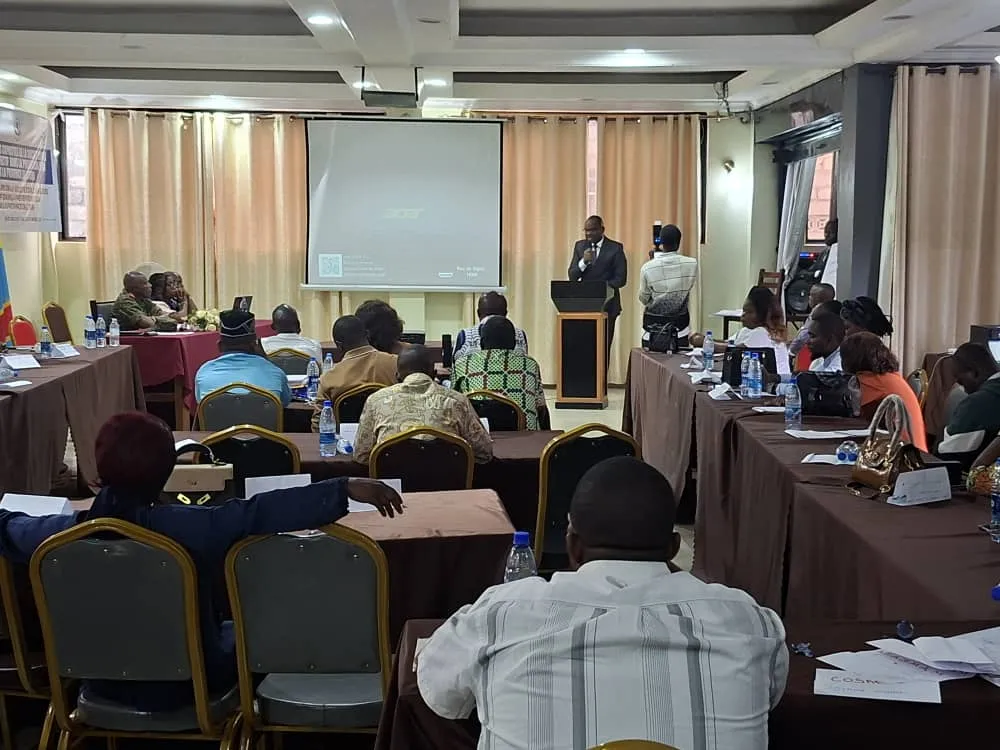
From 13 to 16 April 2026, the United Nations Organization Stabilization Mission in the Democratic Republic of the Congo (MONUSCO), through its Civil Affairs Section, facilitated a capacity‑building workshop for civil society actors in Bunia, the capital of Ituri Province. The workshop was organized by the NGO Mwangaza Peace.
The initiative aimed to strengthen the role and active engagement of civil society in conflict prevention, management and transformation, in a security context still marked by recurrent violence and persistent community tensions.
The workshop brought together 50 participants, including 21 women, from non‑governmental organizations and community‑based associations operating across the five territories of Ituri Province—Aru, Djugu, Irumu, Mahagi and Mambasa—as well as representatives from the Ituri Provincial Civil Society Coordination and the city of Bunia.
Key Themes for a More Effective Civil Society
Over the course of four days, participants were equipped with essential knowledge and skills, particularly on lobbying and advocacy techniques, the legal framework governing civil society organizations, and their role in the peace-building process.
The discussions also focused on identity‑based conflicts, conflict management, resolution and transformation, social cohesion, as well as international instruments such as United Nations Security Council Resolution 1325 on Women, Peace and Security and Resolution 2250 on Youth, Peace and Security.
The opportunity was also used to strengthen stakeholders’ capacities towards building a more structured and professional civil society, notably through the reinforcement of Thematic Groups.
Recurrent conflicts and sometimes misdirected advocacy
The collective analysis of Ituri’s socio‑security situation highlighted a shared observation: the persistence of armed and inter‑communal conflicts, often accompanied by a lack of trust and collaboration between the population, civil society, and public authorities.
The Coordinator of Mwangaza Peace, Gloire Mongo, called on civil society actors to demonstrate greater rigor and responsibility, particularly in public denunciations:
“Sometimes, we observe shortcomings in certain advocacy actions relayed on social media or in the media. This can create tensions between the authorities and the population, which is not desirable.”
For participants, it has become essential to prioritize constructive, evidence‑based advocacy efforts oriented toward sustainable solutions, to strengthen peace consolidation.
Advocacy, Neutrality and Dialogue as Guiding Principles
Aware of their key role in the implementation of peace agreements and in community‑based early warning mechanisms, civil society members committed to promoting several fundamental principles: neutrality and impartiality, respect for human rights, inclusion, and non‑discrimination, as well as intra‑ and inter‑community dialogue and peaceful coexistence.
For Innocent Wabekudu, Head of Civil Society in Mahagi, this represents a necessary shift in approach:
“We should not focus only on denunciations. Alerts are important, but we must further develop advocacy and lobbying so that people’s problems find concrete solutions from the authorities.”
A Collective Commitment to Peace in Ituri
At the conclusion of the workshop, participants signed a commitment document and developed a common roadmap, aimed at strengthening the effectiveness of civil society in advocacy initiatives and conflict‑prevention efforts.
This commitment is built around four key pillars:
- the promotion of peace and social cohesion,
- the prevention and transformation of conflicts,
- the promotion of advocacy for peace,
- and the promotion of inclusion, particularly of women and youth.
To operationalize these commitments, civil society actors plan to establish a permanent consultation framework and deploy peace initiatives at provincial, territorial and local levels.
Beyond capacity building, this MONUSCO‑supported initiative also seeks to strengthen collaboration between civil society, local authorities and partners, a prerequisite for sustainable peace in Ituri.
Jean‑Tobie Okala


