


Nyakunde, 22 July 2026 – Life appears to have returned to normal in Nyakunde, a locality in Irumu Territory, about 40 kilometres from Bunia in Ituri Province. On 16 July, the United Nations Organization Stabilization Mission in the Democratic Republic of the Congo (MONUSCO) deployed a mobile operating base in nearby Marabo. According to local health authorities, the resumption of MONUSCO patrols has created the conditions needed to revive the Ebola response. They are now calling for this presence to be sustained over time. Just a week earlier, violence had spread fear, driven several patients from the Ebola Treatment Centre (ETC), and disrupted an already fragile response effort.
Since the Democratic Republic of the Congo declared its 17th Ebola outbreak on 15 May 2026, several treatment centres have come under attack. These incidents have disrupted patient care and complicated efforts by health authorities to contain the spread of the virus.
The violence that shook Nyakunde
On 15 July, one day before MONUSCO's deployment, a series of incidents plunged the town into fear.
According to medical sources, part of the Ebola Treatment Centre compound was vandalized by a group of young people. The demonstrators were protesting the death of the wife of a fighter from the Front patriotique et intégrationniste du Congo (FPIC) at Nyakunde General Referral Hospital.
A few hours later, the situation deteriorated further with the killing of Kakani Tondabo, also known as "Herod", the FPIC leader, in Masiya-Mbandi, between Marabo and Nyakunde. The clashes that followed claimed the lives of five other people. The following day, 16 July, MONUSCO established a mobile operating base in Marabo.
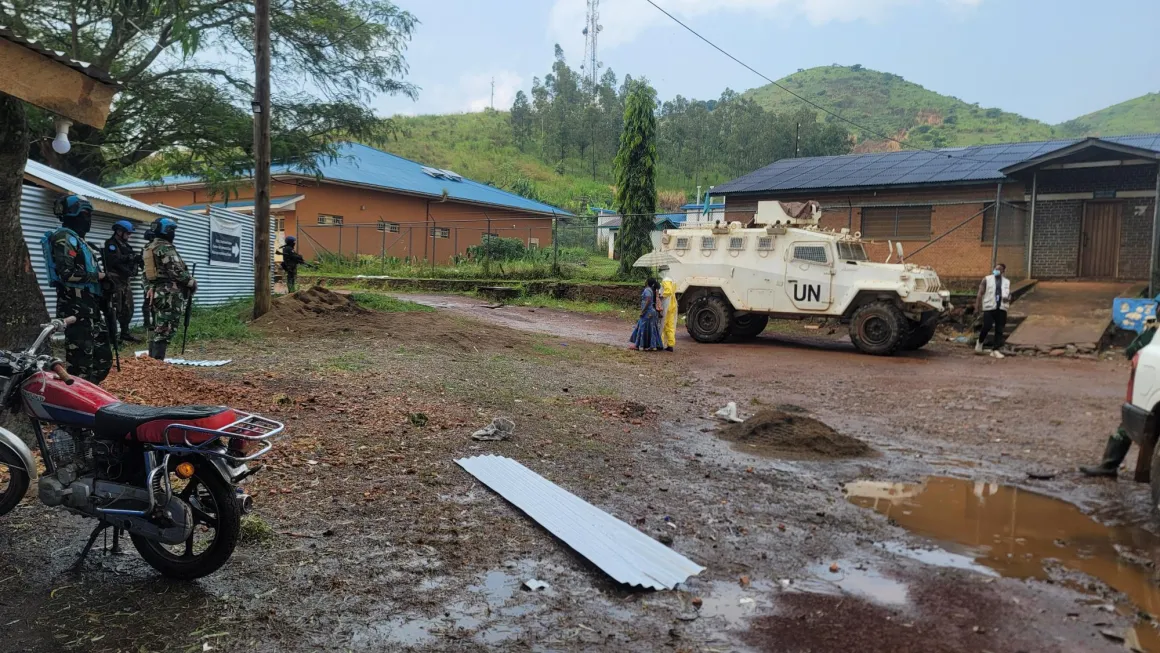
In Marabo, a gradual return to calm
We arrive in Marabo in the middle of the morning. The sky is overcast and the streets are busy. Motorcycle taxis move through the town. In front of small shops, the few handwashing stations still in place serve as a reminder that the Ebola outbreak is far from over, even though daily life appears to have resumed.
Just a few metres from the MONUSCO base, a group of children improvise a football match with a ball made of dried grass. One of them steps forward proudly.
"My name is Mohamed Salah," he says with a smile. When asked what he knows about Ebola, his smile briefly fades. "They tell us we have to wash our hands so we don't catch the disease."
His simple answer reflects both the awareness campaigns carried out in surrounding villages and the way children still perceive the outbreak.
Peacekeepers reassure communities
Under MONUSCO escort, it takes about thirty minutes to travel from Marabo to Nyakunde. Activity is gradually returning. Market stalls are filling up again, residents are returning and medical teams have resumed their work. Yet the trauma remains.
For Consolée Bongise, who is in charge of hygiene and decontamination at Nyakunde General Referral Hospital, the change is evident. "After the violence, people fled to Komanda and Bunia. Today, thanks to MONUSCO and the FARDC, calm has returned."
Major Atiqur, the Indonesian commander of the mobile base, says local residents have gradually regained confidence thanks to regular patrols. "People quickly understood that we had come to help restore security and protect the Ebola Treatment Centre. Today, we receive a warm welcome wherever we go."
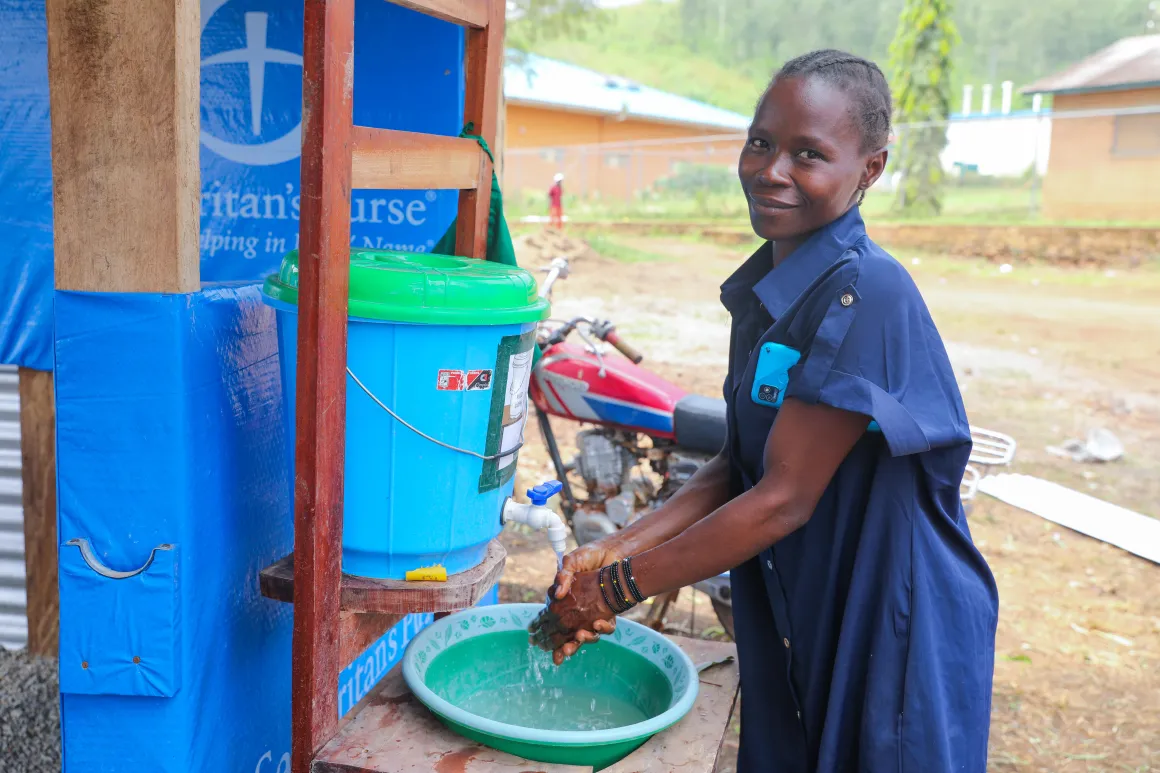
An Ebola treatment centre under strict vigilance
The Ebola Treatment Centre is located opposite Nyakunde General Referral Hospital. Entry is only possible after complying with strict health protocols. Every visitor must wash their hands, undergo a temperature screening and have their shoes disinfected with chlorinated water. These precautions have become routine. Here, everyone knows that even a small lapse can have serious consequences.
During our visit, a woman showing several symptoms consistent with Ebola is admitted to the unit for suspected cases.
A nurse explains the procedure: "We will monitor her condition and carry out an initial test. If the result is negative, a second sample will be taken 48 hours later. If both tests are negative, she will be discharged."
The treatment centre has a capacity of 31 beds. On the day of our visit, only seven are occupied: five by suspected cases and two by confirmed patients.
For Dr. Charles Kashindi, Medical Director of Nyakunde General Referral Hospital, this improvement reflects both growing community awareness and the gradual improvement in the security situation.
"Just a few weeks ago, we were receiving six to seven patients a day. Today, we are seeing only two or three. Community awareness campaigns are beginning to produce results."
Health workers call for a sustained MONUSCO presence
For Maurice Bainga, a field epidemiology nurse, the progress achieved will remain fragile unless security is fully guaranteed.
"Between patrols, we never know what might happen. That is why we are calling for a permanent MONUSCO presence."
For health officials, security has become inseparable from the fight against Ebola. Without it, awareness campaigns, contact tracing and patient care remain at risk.
"Restoring hope"
In this part of Ituri, where the FPIC remains active, peacekeepers remain on constant alert.
Captain Ary commands the patrol accompanying us to Nyakunde. For him, the mission goes far beyond military duties. "Our mission is to restore hope to communities that have gone through extremely difficult times."
In Nyakunde, residents continue learning to live with the threat of Ebola. Regular handwashing has become part of daily life for many families.
As Maurice Bainga reminds us, "Water and soap remain simple but extremely effective tools for preventing the disease."
In this region, where security and public health are closely intertwined, health authorities see the sustained presence of MONUSCO peacekeepers as a decisive factor in consolidating the progress made against Ebola. In their view, only lasting security will allow communities to regain full confidence in the healthcare system.
- Jean-Tobie OKALA


