


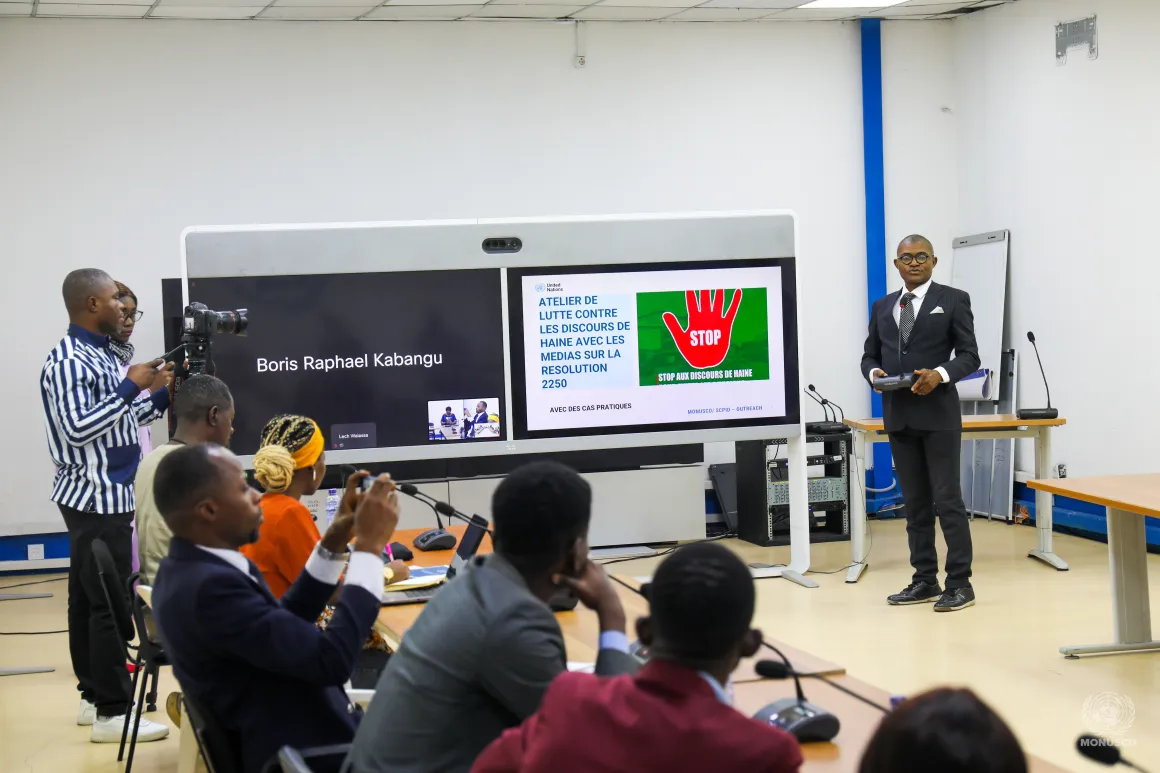
In Kinshasa, from August 18 to 19, young journalists took part in training sessions as part of the Youth, Peace and Security (YPS) agenda. Organized by the National Technical Secretariat for Resolution 2250 (NTS-2250), with the support of MONUSCO, the meeting aimed to raise young journalists’ awareness of the values and skills needed to fully assume their role.
During the first day, discussions focused on the five pillars of Resolution 2250—participation, protection, prevention, partnerships, and disengagement and reintegration—as well as the complementarity between the Youth, Peace and Security (YPS) and Women, Peace and Security (WPS – Resolution 1325) agendas. Participants were also introduced to the principles of conflict-sensitive journalism and the ethical duty to “do no harm.”
The second day enabled participants to deepen their understanding of the fight against toxic speech, information-verification techniques, and the responsibility of newsrooms during times of crisis.
Banning hate speech from the media
Cleaning up media discourse now appears inseparable from conflict prevention and the promotion of social progress. During the training, participants developed greater awareness of the various forms of hate expression—whether verbal, written, or behavioral—and of the devastating impact of false information on national stability and peace processes in the DRC.
For the participants, an analysis of the Rabat Plan of Action—on the prohibition of advocacy of national, racial, or religious hatred—provided a practical framework based on six threshold criteria: context, speaker, intent, content, extent, and likelihood of harm. These criteria enable them to assess the seriousness of problematic statements that may appear in certain media discourse.
They therefore came to understand that responsible reporting requires heightened vigilance: rigorous moderation, rejection of xenophobic content, strict adherence to professional ethics, and keeping the airwaves closed to actors seeking to exploit hatred.
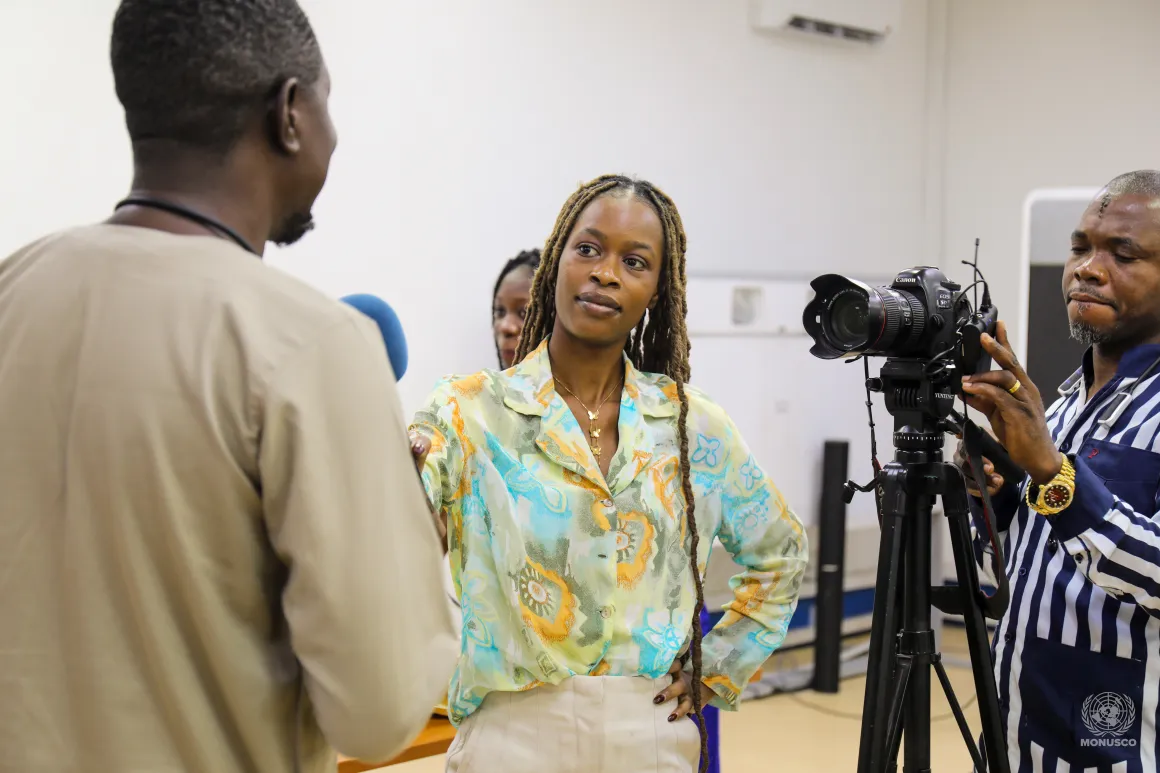
For Joselyne Muteba, a journalist with Ecofin Télévision, media professionals are above all mass educators.
“If we broadcast hate speech, we encourage vulnerable or less-educated segments of the population to cause disorder that disrupts social peace. Our role is to be sufficiently equipped to know what to say and to encourage citizens not to fall victim to manipulation,” she explains.
Who is your source?
Positioned at the heart of the information chain, young professionals bear a major responsibility: to fuel public debate with verified facts or risk amplifying manipulative rumors.
This technical component provided participants with a methodology for debunking disinformation and half-truths designed to mislead public opinion, while equipping them to systematically assess the accuracy of information, its narrative, the language being targeted, the authenticity or artificial nature of the content, the boundary between opinion and incitement, as well as potential harm.
By incorporating the use of modern digital tools such as Google Lens and InVID to analyze images and videos, these young journalists are now better positioned to act as a bulwark against disinformation, particularly on social media.
In times of crisis, the media’s social responsibility takes on critical importance. Journalists were reminded that a press card is not a bulletproof vest, and that the safety of both media teams and their sources depends above all on the rigor of the work they produce.
Practicing the profession requires systematic cross-checking of sources, balanced perspectives, and, above all, constant ethical judgment enabling journalists to determine when information should be withheld in order to avoid putting lives at risk.
Regarding daily engagement within newsrooms, Joselyne Muteba emphasizes the need to provide young people with constructive spaces for expression: “In our newsrooms, we must continuously support and promote young people’s initiatives, give them a voice on their needs, and create spaces for debate to advance their contribution to the country’s development.”
This training is expected to lead to the establishment of a network of focal points within newsrooms, ready to ensure sustained monitoring of YPS issues and maintain links with the National Technical Secretariat.
The workshop highlighted the importance of responsible journalism and strengthened young people’s commitment to working for peace. By serving as a partner, MONUSCO is renewing its support for raising awareness among young people in the DRC about these values and the Resolution 2250 agenda.
-Nathan K.


