


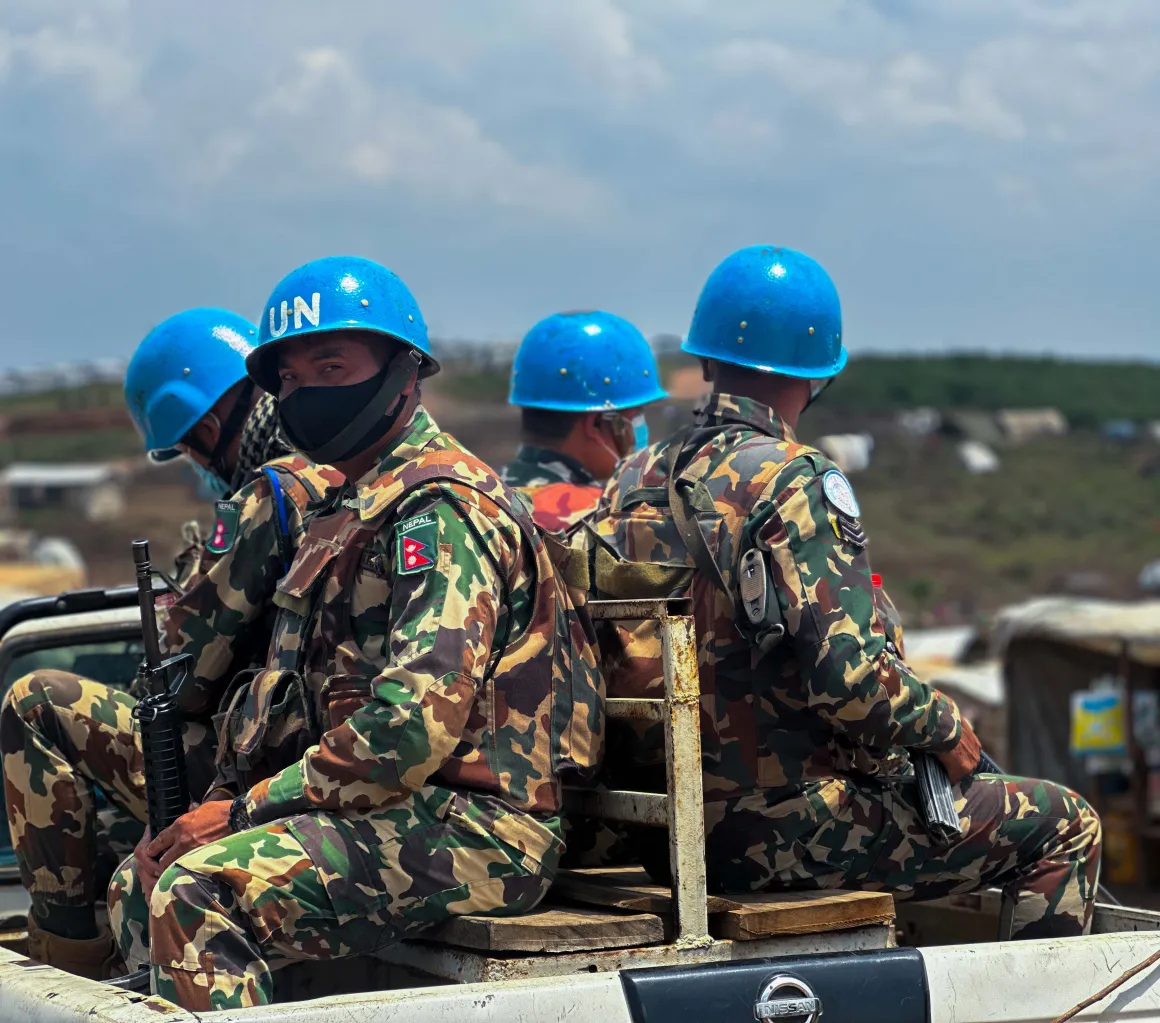
In Fataki, in Djugu Territory in Ituri, the first light of day reveals each morning the scale of population displacement caused by the activities of armed groups. Under the protection of the Blue Helmets, hundreds of families living under tarpaulins and in makeshift shelters nevertheless strive to rebuild a daily life around the MONUSCO base.
It was in this context that, on 6 February 2026, a delegation of Member States sitting on the Fifth Committee of the United Nations, responsible for budgetary, administrative and financial matters, visited the MONUSCO Nepalese contingent base in Fataki. The delegation met with the Blue Helmets, local authorities and displaced populations to assess needs and review the Mission’s impact in terms of the protection of civilians.
A MONUSCO base as a place of refuge
For several months, armed clashes along the Lodda–Djaiba–Fataki road axis have forced many people to flee their villages. In January 2026, approximately 5,500 civilians found refuge in the vicinity of the United Nations base in Fataki. Among them were about 1,900 women and 1,400 children seeking protection from the Nepalese Blue Helmets.
“We salute the MONUSCO Blue Helmets for the protection we receive,” said one representative of the displaced persons.
“Thanks to their presence,” he added, “our children can sleep safely and we can access our fields without fearing for our lives. We hope this support will continue until peace is fully restored.”
Jean-Baptiste Banga, a displaced person from Lodda, shared the same sentiment:
“Without MONUSCO, it would be difficult to live in these sites. Even to go to the fields, we need their protection. Above all, we call for the disarmament of armed groups so that we can return home and resume a normal life.”
This call for lasting peace, which would allow each family to return to its village and rebuild a life disrupted by armed violence, is echoed across the displaced communities.
Strengthened operational efforts
Located in the eastern part of Ituri Province, Djugu Territory covers an area of approximately 8,730 km² and is home to nearly three million inhabitants. For several years, the area has been affected by the activities of armed groups, notably CODECO (Cooperative for the Development of the Congo) and CRP (Convention for Popular Revolution), resulting in mass displacement of civilians, loss of life and serious human rights violations.
In response to these challenges, MONUSCO, in coordination with the Congolese army, has intensified its presence. In 2025, more than 5,600 patrols were conducted in the area of responsibility of the Nepalese contingent in Ituri, including nearly 800 joint patrols, to secure road axes, markets, schools and places of worship.
This operational support by the United Nations Mission was saluted by the Administrator of Djugu Territory, Ruffin Mapela: “We salute MONUSCO for its operational and security support in Djugu Territory. Overall, thanks to the joint efforts of MONUSCO and the FARDC (Armed Forces of the DRC), the situation is gradually stabilizing, even though pockets of tension persist, particularly in Bule, where clashes continue between CRP elements and the FARDC.”
“Other armed groups are now almost inactive following the Aru I and II agreements, the local peace process supported by the authorities and MONUSCO,” he added.
The Territory Administrator also highlighted the existing operational coordination through joint patrols with Congolese soldiers, as well as the strengthening of the community alert system, enabling a more rapid response in the event of threats from armed groups.
An engagement beyond the security component
Beyond military operations, MONUSCO is implementing several quick-impact projects in its areas of intervention, including road rehabilitation, bridge construction and the installation of solar streetlights in Lodda, Djaiba, Pimbo and Gina. These initiatives have benefited more than 140,000 people, contributing to improved mobility, enhanced night-time security and the revival of economic and social activities.
In the displaced persons sites of Lodda and Djaiba, communities continue to call for a safe return to their villages, an acceleration of the disarmament process and strengthened humanitarian assistance.
In Ituri, MONUSCO continues its engagement alongside the Congolese Government and local communities to protect populations and help create the conditions for lasting stability.
-Didier Vignon Dossou-Gbakon


